Rolling out display glasses to a team: identities, fleet, rules
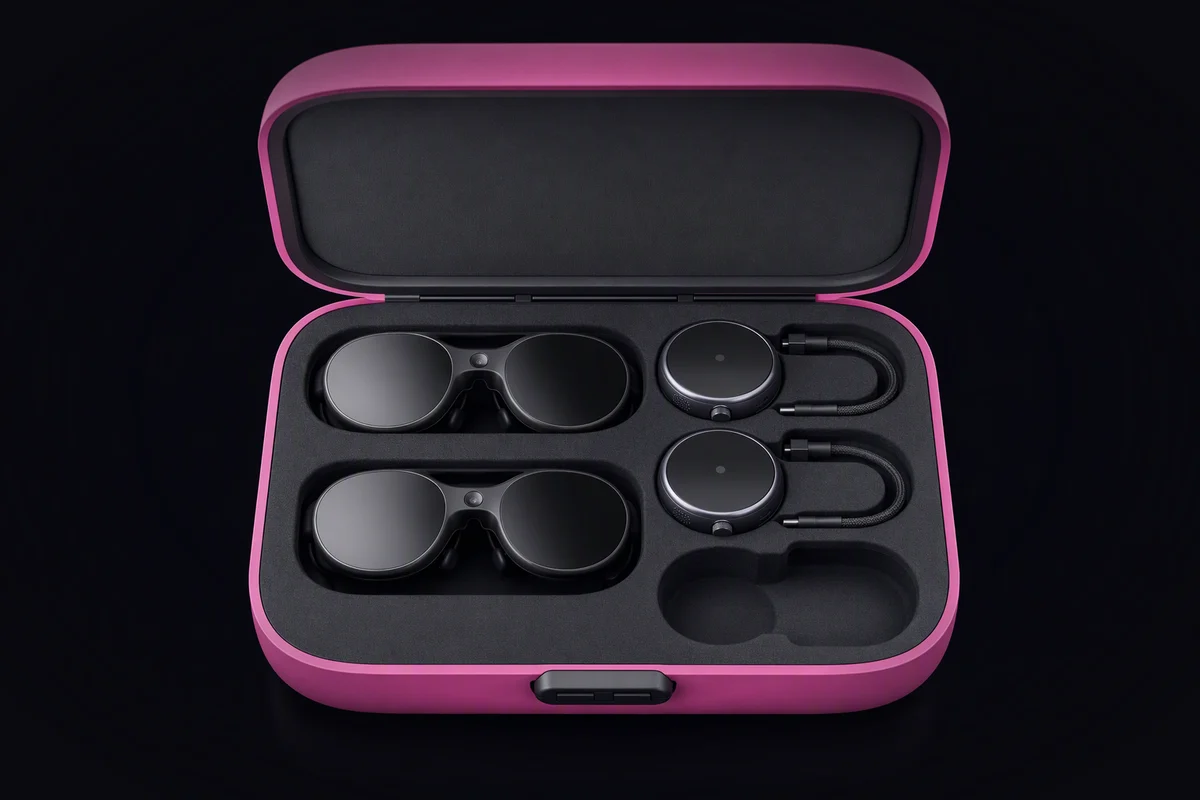
Picture a company that maintains refrigeration in shops and restaurants. Its manager buys four pairs of display glasses for the field team, the kind XREAL has just started taking orders for: Aura, built with Google on Android XR, with Gemini built in and a compute puck in the pocket. The idea is sound. A technician on a ladder behind a cold room sees the wiring diagram without climbing down, and a senior colleague in the office can see what he sees.
Three weeks later each technician has signed the glasses in to his own Google account, because that was the quickest way through setup. One pair lives in a van and is shared between shifts. A puck was left on a restaurant counter for a night. The footage of a customer’s kitchen sits in a personal photo library. And nobody can say which pair runs which software version.
The company is hypothetical, and Aura is not shipping to Europe in its first wave anyway: XREAL lists the United States, Canada, Japan and South Korea first, with more markets in 2027. The questions apply to any head-worn device with a camera, and they arrive with the first pair.
The real cause: an identity with a camera, treated as an accessory
Glasses that see, hear and can act through an assistant are not a screen accessory. They are a person’s identity with a camera on it, and the puck in the pocket is a full computer: XREAL lists a fingerprint reader, GPS and full developer access over ADB on it. Rolling out glasses is an identity and data project with hardware attached. The hardware is the part that arrives in a box; everything else has to be decided.
Where rollouts of head-worn devices go wrong
Personal accounts on company devices. Setup asks for an account and the fastest one is the technician’s own. From that moment the photos, notes and assistant history of company work belong to a private account, and leave with the person.
Shared glasses, shared identity. A pair that moves between people makes every action through it anonymous. Who confirmed the repair, who asked the assistant to order the part: the record says “the van”.
No camera rules. Where the camera may be on, whether customers are told, where footage goes and when it is deleted. The privacy light tells people they are filmed; it does not ask them. EU rules on data protection apply to the company, not to the glasses.
Developer access left open. Full ADB is a real strength for building and testing, and a pocket computer with ADB explains why. On a fleet device in a van it is also a door, and someone has to decide who may open it.
A lost puck is a lost computer. It holds the session, the cache and whatever the apps keep locally. A lost puck needs the same procedure as a lost laptop: lock, revoke, replace.
Nobody knows where the frames go. XREAL does not set out which parts of the assistant’s work run on the puck and which in the cloud. A rollout that cannot answer that cannot answer a customer.
No spares, no charging routine. A battery in the pocket has to be charged somewhere. A pair that breaks or runs flat sends the technician back to the old way of working for the rest of the week.
How we approach a rollout
KYBERTIS does not sell or deploy XREAL or Google products. What we bring to a company is a way of deciding and rolling out head-worn devices that keeps the company’s identities and data its own, the same approach as rolling out KyberDeck to a team.
Decide first whether glasses earn their place. Name the jobs where hands are busy and the information is needed at that moment. Display glasses on the shop floor sets out where they help and where they do not.
One identity per person, under company accounts. Each pair is enrolled to a named person, signed in to an account the company controls, before it leaves the office.
Camera rules written and told. Where the camera is on, how customers are informed, where footage is stored and when it is deleted. Written once, read to every wearer.
Developer access off on the fleet. On for the people who build and test, off for everyone else, and recorded either way.
A fleet list someone keeps. Glasses, puck, person, software version, condition. Checked on a schedule and first when anything odd happens.
Spares and a swap procedure. A small pool sized with you, and a written way to move a person’s setup to a spare without borrowing a colleague’s pair.
A leaver day. Glasses back, account revoked, company data kept, private data returned.
An exit from the platform. If the company builds on Android XR, the way out belongs in the plan from the first day: Android XR with an exit clause.
Support for whatever we deploy comes with an SLA and an exit clause; the details are agreed in the contract. Nothing is for sale yet, and the KYBERTIS homepage has the honest state of the work. For the form itself, glasses with a puck looks at what the design gets right.
A test you can run today
List every device in your company that has a camera and can be carried into a customer’s premises: phones, tablets, body cameras, the drone someone bought last year. For each, answer five questions: whose account is it signed in to, who holds it today, where does its footage go, what happens when it is lost, and what happens on the day its holder leaves.
Every answer that reads “we would have to check” is something to settle before the first pair of glasses arrives, because the glasses will make it more visible, not less.
- display glasses
- XREAL Aura
- rollout
- identity
- devices